


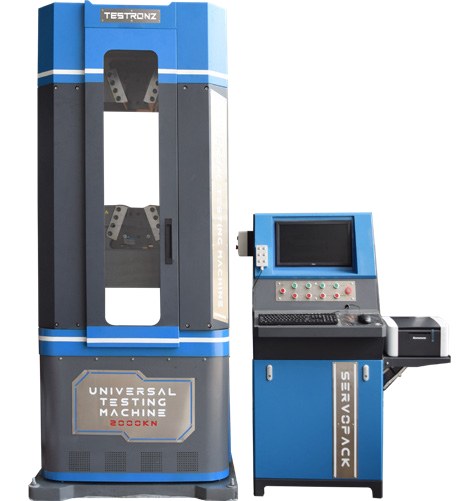
A concrete testing machine applies a controlled load to hardened concrete specimens (cubes, cylinders, beams or cores) and records the load at failure. That single number decides whether a pour is accepted, whether formwork can be struck and whether a mix design is approved. This guide explains the machine types, the standards they must meet and how to choose the right one for a lab or site.
What a Concrete Testing Machine Does
Every concrete testing machine has four parts: a rigid load frame, a hydraulic power pack that drives the piston, a load measuring system (pressure transducer or load cell) and a controller that keeps the loading rate constant and captures the peak load. The standards care most about three things: frame stiffness, platen geometry and the accuracy of the indicated load.
Main Types of Concrete Testing Machine
1. Compression testing machine
The most common type. It crushes 100 or 150 mm cubes and 100 x 200 or 150 x 300 mm cylinders to EN 12390-3 / ASTM C39. Capacities run from 1,500 kN for general ready-mix work to 3,000 kN and above for high-strength concrete. For capacity and accuracy class selection in detail, see our compression testing machine selection guide.
2. Flexural testing machine
A lower-capacity frame (typically 100 to 300 kN) with a 3-point or 4-point bending jig for beams to EN 12390-5 / ASTM C78. Fibre-reinforced concrete to EN 14651 needs closed-loop servo control and a CMOD or deflection transducer, because the test continues past first crack.
3. Combined compression and flexural machine
Two frames sharing one power pack and controller. It suits labs that test cubes and beams daily but have limited floor space, and it keeps one calibration schedule for both frames.
4. Servo-controlled and automatic machines
Automatic machines hold the stress rate within tolerance without an operator watching the gauge, detect failure, retract the piston and export results to LIMS or a printer. For accredited labs this removes the biggest source of scatter: an inconsistent loading rate.
5. Universal testing machine
Where the same lab also tests rebar and steel, a universal testing machine covers tension, compression and bend. It does not replace a dedicated concrete compression frame for high-volume cube testing, but it complements one.
Standards the Machine Must Meet
| Requirement | EN 12390-4 | ASTM C39 |
|---|---|---|
| Load accuracy | Class 1 (within 1%) over the working range, verified to EN ISO 7500-1 | Within 1.0% of indicated load, verified to ASTM E4 |
| Loading rate | 0.6 ± 0.2 MPa/s, constant | 0.25 ± 0.05 MPa/s |
| Platens | Hardness, flatness and spherical seat tolerances specified | Spherically seated upper block, hardened bearing faces |
| Verification interval | At least annually and after moving or repair | At least annually (13 months max) |
Machines are normally verified to EN ISO 7500-1 by a laboratory accredited under ISO/IEC 17025.
How to Choose a Concrete Testing Machine
- Specimen size and strength. Peak load = strength x area. A 150 mm cube at 60 MPa needs 1,350 kN, so a 2,000 kN frame leaves safe headroom. Aim to work between 10% and 80% of capacity.
- Test volume. Under about 20 specimens a day, a manual or semi-automatic machine is enough. Above that, automatic control pays back in time and consistency.
- Test types. Cubes only, or beams and cores too? Cores from a core drilling machine need suitable spacers and a frame with enough daylight.
- Frame construction. Welded or cast frames with four columns give the stiffness EN 12390-4 expects at high load.
- Calibration and support. Local verification, spare parts and service shorten downtime more than any feature on the spec sheet.
Supporting Equipment Around the Machine
Reliable results also depend on what happens before the specimen reaches the platens: correct cube moulds and curing, capping or grinding for cylinders, and non-destructive checks such as the rebound hammer and UPV tester on the structure itself. For a full list, see the concrete testing equipment checklist.
Frequently Asked Questions
What capacity concrete testing machine do I need?
For 150 mm cubes up to about 60 MPa, 2,000 kN is the usual choice. For high-strength concrete above 80 MPa, or for 150 x 300 mm cylinders at high strength, choose 3,000 kN.
How often must a concrete testing machine be calibrated?
At least once a year, and again whenever it is moved, repaired or its readings are in doubt. Keep the verification certificate with the machine for audits.
Can one machine test both cubes and cylinders?
Yes. The same frame tests both, provided the platens are large enough and the spherical seat and spacers suit the specimen height.
Is an automatic machine worth the extra cost?
For accredited or high-volume labs, yes. Constant stress rate and automatic failure detection reduce result scatter and operator time, and digital records simplify audits.
Recommended Apparatus
NL Scientific manufactures the ELECTRO-HYDRAULIC Servo Control Universal Testing Machine 2000kN (6KS) for this method. Browse the full Concrete Testing Equipment range or request a quotation from our engineers.
