


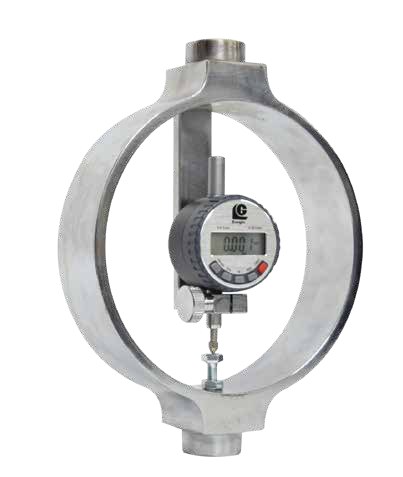
The unconfined compression test (UCT) is the quickest laboratory way to measure the strength of a cohesive soil. A cylindrical specimen is loaded axially with no lateral confinement until it fails, giving the unconfined compressive strength qu and, from it, the undrained shear strength used in foundation and slope design.
What the Test Measures
The test records axial load against axial strain. The peak stress, or the stress at 15% strain if no peak occurs, is qu. Because the cell pressure is zero, the undrained shear strength is taken as cu = qu / 2. The method suits saturated clays and silts that stand unsupported. It is not valid for dry, fissured or granular soils, which need the triaxial test instead.
Apparatus Required
- Load frame with a constant rate of strain drive (about 0.5 to 2% per minute)
- Proving ring or load cell, sized so failure occurs within its calibrated range
- Dial gauge or displacement transducer reading to 0.01 mm
- Specimen extruder, split mould and trimming tools for 38 mm or larger diameter samples
- Balance, moisture tins and oven for water content
Specimen Preparation
- Extrude the sample from the tube and trim a cylinder with height about 2 to 2.5 times the diameter.
- Square the ends so they are flat and parallel; avoid disturbing the soil structure.
- Measure diameter at top, middle and bottom, and the height; record the mass.
- Work quickly or in a humid room so the specimen does not lose moisture.
Test Procedure
- Centre the specimen between the platens and bring the upper platen just into contact.
- Zero the load and displacement readings.
- Apply axial strain at a constant rate so failure occurs in roughly 5 to 15 minutes.
- Record load and deformation at regular strain intervals until the load falls or 15% strain is reached.
- Sketch the failure mode (shear plane or bulging) and take the whole specimen for water content.
Calculation & Reporting
Axial strain ε = ΔL / L0. Correct the area for bulging: A = A0 / (1 − ε). Stress at each reading is load divided by corrected area. Plot stress against strain; the peak gives qu and cu = qu / 2. Report the sample depth, dimensions, water content, bulk density, strain rate, qu and the failure sketch.
Typical Values
| Consistency | qu (kPa) |
|---|---|
| Very soft | < 25 |
| Soft | 25 to 50 |
| Medium | 50 to 100 |
| Stiff | 100 to 200 |
| Very stiff | 200 to 400 |
| Hard | > 400 |
Frequently Asked Questions
What is the difference between the unconfined compression and triaxial UU tests?
The UU triaxial test applies a cell pressure and seals the specimen in a membrane. The unconfined test is a UU test with zero cell pressure, so it is faster and cheaper but only reliable for intact, saturated cohesive soil.
Why stop at 15% strain?
Plastic clays may keep deforming without a clear peak. The standards define failure at 15% strain in that case so results remain comparable.
Can I test remoulded samples?
Yes. Testing the same soil undisturbed and remoulded at equal water content gives the sensitivity ratio, an indicator of how much strength the clay loses when disturbed.
For a complete geotechnical lab setup, see our soil testing equipment checklist.
Recommended Apparatus
NL Scientific manufactures the Load Proving Ring (DIGITAL Readout) for this method. Browse the full Soil Testing Equipment range or request a quotation from our engineers.
