


The triaxial test measures soil shear strength under a controlled confining pressure and drainage condition. By testing matched specimens at several effective stresses, the laboratory derives cohesion and friction parameters for stability, foundation and earthworks design.
What the Test Measures
A cylindrical, membrane-enclosed specimen is subjected to cell pressure and increasing axial stress. Axial load, deformation and, where required, pore-water pressure and volume change are recorded. Mohr circles or stress-path interpretation provide total- or effective-stress strength parameters c and φ.
Specimen quality is critical. Describe sampling, orientation, dimensions, density and water content. Index data from the Atterberg limits test helps explain drainage behaviour and sensitivity, but does not replace measured strength.
UU, CU and CD Variants
Unconsolidated-undrained testing, associated with ASTM D2850, prevents drainage during pressure application and shear. It is quick and provides total-stress undrained strength for rapid loading checks. Consolidated-undrained testing under ASTM D4767 first consolidates the specimen, then shears without drainage while measuring pore pressure. This permits effective-stress interpretation and is a standard choice for many design problems.
Consolidated-drained testing under ASTM D7181 allows drainage throughout. It is appropriate for free-draining soils and long-term behaviour, but cohesive specimens require very slow shearing. State the variant prominently: the resulting parameters answer different engineering questions.
Apparatus Required
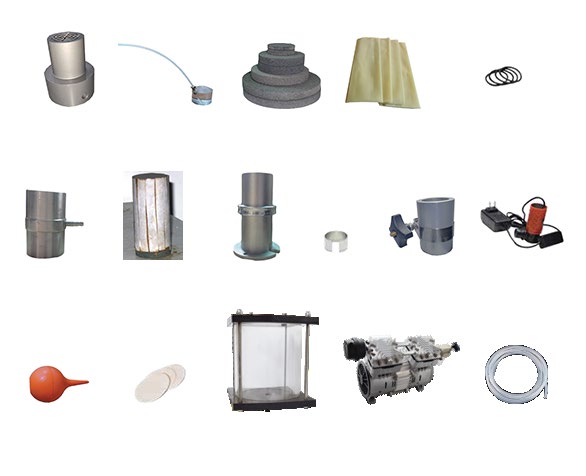
- Triaxial cell and base suitable for 38–100 mm specimens and intended pressure.
- Stiff load frame with controlled strain rate, load cell and displacement transducer.
- Cell- and back-pressure controllers with de-aired water.
- Pore-pressure transducer, volume-change device, porous discs, membrane and seals.
- Preparation tools, balance and moisture-content equipment.
Build a channel schedule for each 38–100 mm specimen series, including cell pressure, back pressure, pore pressure, axial force, displacement and volume change. Select ranges that preserve resolution at the lowest consolidation stress without risking overload at failure. Saturate porous discs and flush every line with de-aired water before the specimen is enclosed. Verify pressure transducers against the same reference and check load-frame pacing at the strain rates expected for UU, CU and CD work. Record membrane batch, thickness and correction where applicable. A pre-test leak check should hold pressure with valves isolated; unexplained controller movement during that check must be resolved before valuable undisturbed material is mounted. Keep spare O-rings, membranes and saturated porous elements ready so a damaged seal does not waste a prepared specimen.
Procedure
- Measure and mount the specimen between saturated porous discs, fit the membrane and check seals.
- Fill the cell, apply initial pressures and flush measurement lines without imposing damaging effective stress.
- For CU or CD work, increase back and cell pressure to saturate. A B-check of at least 0.95 is the stated target.
- Consolidate under the specified effective cell pressure and record volume change until the completion criterion is met.
- Select an axial strain rate slow enough for the required drainage response, then shear while recording all channels.
- Continue to the specified strain or post-peak condition, inspect the failure and determine final moisture content.
Calculation, Reporting and Use
Correct axial area as required and calculate deviator stress from axial force. For CU tests, subtract measured pore pressure from total principal stresses to obtain effective stresses. Plot stress paths or Mohr circles for the series and fit the failure envelope using the specified interpretation. Report c and φ with stress basis, drainage condition and fitting method.
Check transducer zeros, membrane corrections, saturation evidence and consolidation records before accepting the result. A broken seal invalidates drainage control. A direct shear test is a simpler alternative for defined shear planes and granular materials, but cannot reproduce the same stress path or pore-pressure measurement.
Common Errors & How to Avoid Them
- Trapping air in drainage lines lowers pore-pressure response; flush with de-aired water and verify saturation before mounting.
- Increasing back pressure without matching cell pressure can damage the specimen; preserve the intended effective stress during saturation.
- Accepting a B-value below 0.95 compromises the stated target for CU interpretation; continue saturation or document why the specimen cannot qualify.
- Shearing too quickly prevents drainage in CD work or creates unintended excess pore pressure; derive strain rate from consolidation behaviour.
- A pinched membrane adds resistance and leaks; inspect its seating and O-rings before filling the cell.
- Using uncorrected area through large strain biases deviator stress; apply the method’s changing-area calculation.
Zero each pressure and displacement channel under the correct physical condition, because an electronic zero cannot repair a blocked porous disc. Review volume-change continuity and pore-pressure response during the run. If either shows a sudden discontinuity, pause interpretation until tubing, controller movement and membrane integrity have been checked before accepting the plotted failure envelope.
Frequently Asked Questions
Which triaxial test should I specify?
Use UU for rapid total-stress checks, CU with pore-pressure measurement for effective-stress design, and CD for free-draining soils or drained behaviour.
How long does a CU triaxial test take?
A CU triaxial test usually takes 2–5 days per specimen, including saturation and consolidation.
Recommended Apparatus
NL Scientific manufactures the Advanced Triaxial Testing System for this method. Browse the full Soil Testing Equipment range or request a quotation from our engineers.
