


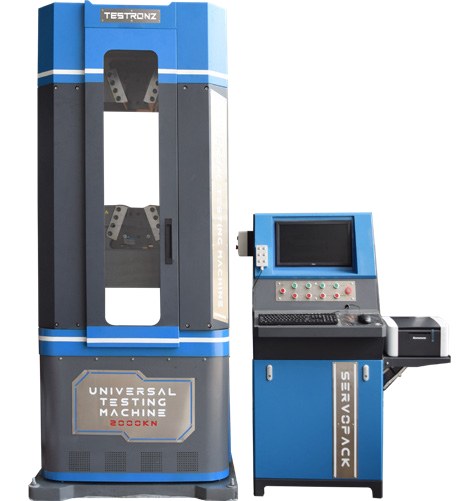
A compression testing machine loads concrete cubes or cylinders to failure under controlled axial compression. Capacity is important, but stiffness, force accuracy, platen geometry, alignment and loading-rate control determine whether the resulting strength is trustworthy.
What the Machine Does
The hydraulic system raises a piston and transfers force through hardened platens into a centred specimen. A force transducer and indicator record maximum load; strength is calculated from load divided by loaded area. The complete crushing method is covered in our concrete compression test guide.
EN 12390-4 addresses machine performance, including Class 1 force accuracy, load indication, platen hardness and flatness, spherical seating and alignment. A certificate alone is insufficient if dirty platens, excessive clearance or a sticking seat changes how load reaches the specimen.
Capacity Selection
Typical capacities are 1500, 2000 and 3000 kN. Calculate expected failure load from specimen area and maximum anticipated strength, then retain operating headroom. A 150 mm cube has 22,500 mm² loaded area, so 80 MPa corresponds to 1800 kN. A 2000 kN machine therefore covers 150 mm cubes beyond 80 MPa only narrowly; select greater capacity when higher strengths or comfortable headroom are expected.
A cylinder has a different loaded area and requires suitable platens or distance pieces. Confirm daylight, piston travel and the safe minimum and maximum stack height for every mould size. Oversizing can compromise low-range utilisation, so review the verified force range too.
Manual, Semi-Automatic and Automatic Control
Manual machines rely on the operator to adjust the valve while watching the indicated pace. Semi-automatic systems simplify loading and return but may still require intervention. Fully automatic closed-loop control holds the programmed stress rate, logs the curve and stops after failure.
For EN 12390-3 concrete testing, the stress rate is 0.6 ± 0.2 MPa/s. Automatic pace control removes operator adjustment error, often the largest avoidable source of scatter. It does not remove the need for correct specimen dimensions, curing, centring and clean bearing faces.
Platens, Fixtures and Safety
Use hardened, plane platens sized for the specimen. The spherical seat must rotate freely before loading and then stabilise under force. Distance pieces should be purpose-made, centred and rated for full capacity. Cylinder testing may require end preparation and appropriate retaining arrangements.
Interlocked safety doors and fragment shields contain debris without obscuring the test. Inspect hydraulic hoses, fittings and guards; never reach into the load space while pressure is applied. Flexural frames or attachments extend utilisation where their geometry and capacity comply with the method; see our concrete flexural strength guide.
Ask the manufacturer to demonstrate a 150 mm cube stack at the upper expected load and a cylinder arrangement at the lowest routine load. This exposes inadequate daylight, unsuitable distance pieces and poor low-range indication before purchase. Confirm the 1500, 2000 or 3000 kN frame can maintain EN 12390-3 pacing without valve hunting. Installation planning must cover oil volume, heat dissipation, fragment clearance, level foundation and electrical isolation. Keep platen-cleaning tools, hydraulic filters, door-interlock parts and the correct oil grade on site. The annual EN 12390-4 visit should include force indication, seating and platen condition rather than calibration of the display alone.
Verification and Buying Checklist
Verify force at least annually to the applicable Class 1 requirements and after relocation, repair or suspected overload. Between calibrations, use a stable check item or other documented intermediate check to identify drift. Also inspect platen flatness, seating and indicated pace.
Specify specimen types, maximum strength, daily throughput, supply voltage, data format, guarding, available service and calibration scope. Request demonstration of rate control using the largest specimen. A clear requirements schedule prevents buying excess nominal capacity while missing a critical platen or software function.
Specification Checklist Before You Buy
- Calculate failure loads for every cube and cylinder size, then choose 1500, 2000 or 3000 kN with sensible reserve.
- Require EN 12390-4 Class 1 accuracy over the laboratory’s working interval and obtain the proposed verification points.
- List platen diameters, hardness and flatness, spherical-seat design, distance pieces and maximum vertical daylight.
- Specify closed-loop 0.6 ± 0.2 MPa/s pace control, result storage, data export and manual recovery after power loss.
- Confirm interlocked fragment doors, hose ratings, emergency stop, piston over-travel protection and safe debris removal.
- Record voltage, phase, oil grade, heat rejection, floor capacity and access dimensions for installation.
Price the machine with commissioning, annual force verification and training rather than treating these as later extras. Request spare seals, a filtration kit and local availability of pressure transducers. If flexural testing is planned, obtain the frame rating, roller geometry and connection details in writing. A witnessed factory test using the intended specimen stack will expose clearance and pacing problems before shipment.
Frequently Asked Questions
What capacity compression machine do I need?
A 2000 kN machine covers 150 mm cubes beyond 80 MPa, with the required 0.6–0.8 MPa/s pacing included; allow more headroom for higher-strength work.
What is the difference between manual and automatic compression machines?
Automatic pace control removes operator loading-rate error, which is often the largest avoidable source of scatter in compression results.
Recommended Apparatus
NL Scientific manufactures the ELECTRO-HYDRAULIC Servo Control Universal Testing Machine 2000kN (6KS) for this work. Browse the full Concrete Testing Equipment range or request a quotation from our engineers.
