


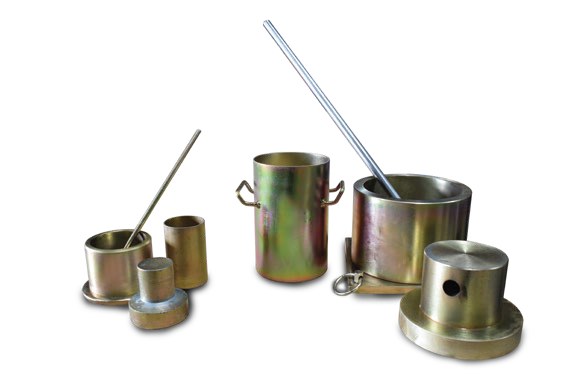
The aggregate crushing value test quantifies resistance to breakdown under a gradually applied compressive load. The result is the percentage of a standard 14–10 mm sample crushed sufficiently to pass 2.36 mm; a lower value indicates stronger aggregate.
What the Test Measures
ACV represents crushing behaviour under slow loading, relevant to aggregate exposed to compressive contact in pavement and concrete. It differs from sudden impact and abrasion. Use the aggregate impact value test for impact toughness and the Los Angeles abrasion test for combined abrasion and impact.
These indices are complementary, not interchangeable. Mineralogy, shape and internal defects can affect each differently. Compare a result with the project or road-authority requirement for the stated source and application.
Apparatus Required
- 150 mm internal-diameter steel cylinder, plunger and base plate maintained clean and undamaged.
- Compression machine capable of applying 400 kN smoothly over 10 minutes.
- 14.0, 10.0 and 2.36 mm test sieves.
- Standard tamping rod, balance, ventilated oven and trays.
Verify sieves and force measurement on schedule. Check that the plunger slides freely without excessive clearance and that bearing faces are plane. Prepare the specified grading using the practices in our sieve analysis guide.
Before an ACV series, measure the cylinder, inspect the plunger for free axial travel and remove grains embedded on either bearing face. Verify the compression machine at loads surrounding 400 kN and confirm its controls can complete the ramp in 10 minutes without a final jump. Prepare enough oven-dry 14–10 mm aggregate for duplicate determinations from the same representative source. Identify trays for original mass, crushed discharge and 2.36 mm fines so transfers remain traceable. Check balance resolution against the expected fines quantity and reconcile recovered material after sieving. Record individual ACV results rather than overwriting them with a mean, particularly when the aggregate lies near a project limit. Retain the crushed fractions until calculation checks are complete.
Test Procedure
- Oven-dry the sample and isolate material passing 14.0 mm and retained on 10.0 mm.
- Fill the cylinder in three approximately equal layers, tamping each layer 25 times uniformly.
- Level the surface, insert the plunger without shock and place the assembly centrally in the compression machine.
- Apply load smoothly to 400 kN over 10 minutes. Do not use a sudden ramp.
- Release load, collect all material and sieve it on 2.36 mm without losing dust.
- Weigh the original test portion and the mass passing 2.36 mm. Complete the required repeat determination.
Calculation & Reporting
Calculate ACV (%) = fines mass passing 2.36 mm ÷ original sample mass × 100. Check recovered mass and repeatability before reporting the mean as required by the method. Include sample source, grading, preparation, individual values, mean, machine and sieve identification, and any departure.
Loss of fines during transfer gives a falsely low value. Moisture, non-standard grading, uneven tamping and an incorrect loading time also bias results. Retain worksheets showing masses and timing rather than only the final percentage.
Typical Limits and Interpretation
Typical road practice uses ACV values not exceeding about 30% for wearing surfaces and 45% for base courses, but these are generic usage values rather than universal BS clauses. The governing authority or project specification sets acceptance. Values below 10% indicate exceptionally strong aggregate, while values above roughly 35% are generally weak for surfacing.
Consider repeatability and source variability near a limit. A single passing result does not demonstrate consistent production, and a failing value should trigger checks of sampling, fraction preparation and equipment before source conclusions are made.
Common Errors & How to Avoid Them
- Including particles outside the 14–10 mm fraction changes packing and crushing response; prepare the grading with verified sieves.
- Testing damp aggregate adds uncontrolled mass and cohesion; dry to the required condition and cool before weighing.
- Uneven or excessive tamping alters initial density; place three comparable layers and deliver exactly 25 distributed strokes to each.
- Applying 400 kN too quickly creates impact-like breakage, whereas a slow ramp changes exposure; control the full loading period to 10 minutes.
- Losing dust during dismantling or transfer falsely reduces ACV; brush the cylinder, plunger and trays into the test portion.
- Forcing material through 2.36 mm damages particles and mesh; sieve with the prescribed action to a confirmed end point.
Check that the plunger moves freely and remains axial before loading. A dirty base or trapped grain can tilt the assembly and concentrate force. Reconcile recovered mass against the original quantity, retain both individual determinations, and repeat the preparation if the pair fails the applicable repeatability requirement.
Frequently Asked Questions
What is the difference between ACV and AIV?
ACV applies a gradual 400 kN load, while AIV applies 15 hammer blows; both report the percentage of fines passing 2.36 mm.
What is a good aggregate crushing value?
Lower values indicate stronger aggregate; below 10% is exceptionally strong, while above about 35% is generally weak for surfacing.
Recommended Apparatus
NL Scientific manufactures the Standard Aggregate Crushing Value Apparatus for this method. Browse the full Aggregate & Rock Testing Equipment range or request a quotation from our engineers.
