


The vane shear test measures the undrained shear strength, su, of soft saturated fine-grained soil from the torque required to rotate a four-blade vane. It can be performed in a borehole or by pushing equipment from ground level, with a miniature version used on laboratory specimens.
What the Test Measures
Rotation shears a cylindrical soil surface around and above and below the vane. Peak torque provides intact undrained strength. After rapid remoulding, a second measurement provides remoulded strength; their ratio indicates sensitivity and potential structure loss during disturbance.
The method is best for soft to firm saturated clays, broadly below about 200 kPa. Sands cannot sustain the assumed cylindrical surface, and gravel, shells, roots or laminations obstruct the vane and distort torque. Use classification and the Atterberg limits to support interpretation.
Field and Laboratory Apparatus
ASTM D2573 field equipment uses a four-blade vane, normally with height H equal to twice diameter D, extension rods and a calibrated torque head or transducer. A protective shoe or casing limits disturbance during insertion. Rod-friction measurement is required where the arrangement does not isolate it.
ASTM D4648 miniature laboratory equipment uses the same principle on a tube sample or prepared specimen. It is convenient for profiling but sampling disturbance can reduce strength. In both cases, verify vane dimensions, straightness, angular rate and the torque system over the working range.
Test Procedure
- Select a depth in representative saturated fine-grained soil and confirm the apparatus range.
- Advance the vane without rotation to at least five borehole diameters below the disturbed base, or use the specified push-in arrangement.
- Allow only the method-permitted delay, set the torque reading and rotate at 6–12°/min.
- Record torque continuously or frequently through the peak and note irregular response.
- Rotate the vane rapidly for at least 10 revolutions to remould the soil, pause only as specified, then repeat at the controlled rate.
- Determine rod friction where required and correct the measured torque before calculating strength.
For each depth, record vane diameter and height, torque-head serial number, insertion system, borehole diameter and the length of exposed rod. Check the torque channel with its calibrated proving device before the sounding and verify angular drive at 6–12°/min. Establish the rod-friction correction using the actual string arrangement rather than copying a value from another hole. Field notes should describe resistance during insertion, inclusions and any irregular peak trace that suggests gravel contact. Time the interval from arrival at depth to intact testing, then document rapid remoulding revolutions and the delay before the second peak. Preserve both torques so the reported sensitivity ratio can be independently recalculated.
Calculation & Reporting
For a rectangular vane, calculate su = 2T / [πD³(H/D + 1/3)], where T is corrected torque, D is vane diameter and H is vane height. The same relationship is often written su = T/K using the vane constant K. Use consistent SI units and the actual measured dimensions.
Report peak and remoulded su, sensitivity, depth, vane geometry, rotation rate, insertion method, delay, rod-friction correction and soil description. Plot a depth profile rather than presenting isolated values without stratigraphic context.
Interpretation and Limitations
Vane strength is an index derived from an assumed failure geometry and stress distribution. An empirical Bjerrum correction related to plasticity may be required for some stability analyses; apply it only through the selected design method and report both measured and corrected values. Do not treat the correction as part of raw instrument output.
Compare results with sampling, groundwater and other strength data. The direct shear test provides drained response on a defined plane and answers a different question. Suspect gravel contact when torque rises abruptly or the vane cannot advance, and relocate rather than forcing a misleading reading.
Common Errors & How to Avoid Them
- Rotating the vane during insertion remoulds the clay before measurement; push it to depth without twisting the rods.
- Testing too near the borehole base samples disturbed soil; advance at least five borehole diameters below that zone.
- Ignoring rod friction overstates soil torque; measure or eliminate shaft resistance with the apparatus arrangement.
- Exceeding 6–12°/min changes drainage and rate response; use a controlled drive and record actual angular speed.
- Stopping at the first fluctuation can miss peak torque; capture a continuous trace through maximum resistance.
- Insufficient rapid revolutions leave the soil partly intact and inflate remoulded strength; complete at least 10 before retesting.
A bent rod, worn blade or incorrect vane constant directly biases su, so measure geometry and verify the torque head before field mobilisation. Reject locations where gravel contact prevents smooth rotation. Record delays between insertion, peak testing and remoulded testing because thixotropic recovery can alter the reported sensitivity ratio.
Frequently Asked Questions
What soils suit the vane shear test?
The vane shear test suits soft to firm saturated fine-grained soils with undrained strength below about 200 kPa; it is not suitable for sands or gravelly clays.
What is vane sensitivity?
Vane sensitivity is the ratio of peak undrained strength to remoulded undrained strength and indicates structure loss caused by disturbance.
Recommended Apparatus
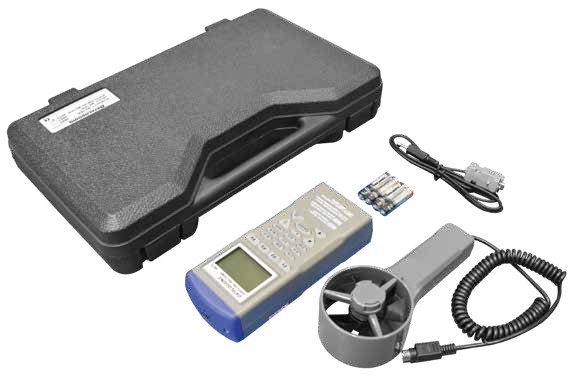
NL Scientific manufactures the MULTI-FUNCTION Vane THERMO-ANEMOMETER for this method. Browse the full Soil Testing Equipment range or request a quotation from our engineers.
