


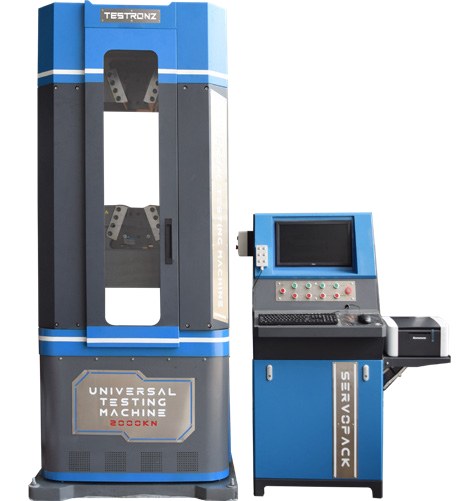
A universal testing machine (UTM) applies and measures controlled force so one load frame can perform tension, compression and bend or flexural tests. The right configuration gives traceable force, extension and displacement data without forcing a laboratory to maintain separate machines for every loading mode.
What a UTM Does
A UTM drives a crosshead or hydraulic actuator while a load cell or pressure-based force system measures specimen resistance. Fixtures convert that movement into axial tension, compression or bending. The controller records force against time, displacement or strain, allowing the software to calculate yield strength, tensile strength, elongation, proof stress and other method-dependent results.
Interchangeability is the principal advantage. Wedge grips hold rebar and metallic coupons, platens apply compression, and rollers support bend or flexural specimens. The frame, fixtures and measurement channels must all be rated for the intended load; a high-capacity frame does not make an undersized grip safe.
Main Types
Electro-hydraulic servo UTMs use a hydraulic power pack and controlled valve to generate large forces. They suit high-capacity rebar and structural-steel work, where robust grips and long duty cycles matter. Modern closed-loop controllers maintain a programmed force, stress or displacement rate.
Electromechanical machines use screws driven by a motor. They are clean, quiet and particularly effective for low-load precision work, plastics, wire and small components. Their displacement control is excellent, but very high capacities are generally less economical. Choose according to the force range and methods actually used, rather than assuming either drive system is universally better.
Key Components
The load frame provides stiffness and alignment. The hydraulic power pack or electromechanical drive supplies motion; a calibrated force channel measures load. Grips must match specimen shape, strength and surface, while compression platens and bend fixtures require correct geometry. An extensometer measures gauge-length strain independently of crosshead movement. Control software should support method stages, rate changes, live graphs, calculations, raw-data export and user permissions.
For a rebar programme, evaluate the UTM as a complete force chain rather than a bare frame. Confirm that wedge grips close securely on every specified bar diameter, the extensometer survives removal before fracture, and the crosshead leaves enough travel for elongation. A 1000 kN hydraulic installation also needs verified floor loading, three-phase supply where specified, oil cooling and safe hose routing. Request ISO 7500-1 calibration points that cover routine bar loads, plus certificates for any separate load cell. Stock jaw inserts, grip springs, hydraulic filters and seals locally; waiting for a small wear part can immobilise an otherwise serviceable machine.
Capacity Selection
Common laboratory capacities run from 100 kN to 2000 kN. Estimate the maximum specimen load from its cross-sectional area and expected strength, then select at least 25% headroom so routine tests are not conducted at the machine limit. Do not oversize excessively: accuracy and resolution at the bottom of the range also matter.
A 600 kN system commonly handles Grade 500 rebar up to 32 mm. A 1000 kN UTM provides useful headroom for bars up to 40 mm and is a practical general steel-lab choice. Confirm grip jaw range, clear distance between columns, crosshead travel and extensometer travel alongside force capacity.
Accuracy, Verification & Applications
For most construction-material laboratories, specify ISO 7500-1 Class 1 force accuracy across the required range. Arrange verification at least annually and after relocation, major repair or any event that could affect the force chain. Our UTM verification and ISO 7500-1 calibration guide explains force proving and classification.
Typical applications include reinforcement bar, plate, fastener, weld coupon and component testing. Fixture and control requirements differ by method. See the rebar tensile and bend test guide for specimen preparation, tensile measurements and bend assessment. Build a method matrix listing capacity, fixtures, rate mode and reporting fields before requesting quotations.
Specification Checklist Before You Buy
- State the highest calculated specimen load and require at least 25% capacity reserve; identify whether 600, 1000 or 2000 kN is appropriate.
- Require ISO 7500-1 Class 1 verification across the actual working range, not solely near full scale.
- List every rebar diameter, coupon thickness and compression or bend fixture, including grip jaw profiles and rated loads.
- Confirm clear column spacing, crosshead travel, test speed range and extensometer gauge lengths before approving the frame.
- Specify electro-hydraulic servo or electromechanical drive, local voltage, phase, frequency, hydraulic cooling and floor loading.
- Request guarded controls, emergency stops, raw-data export, method software, installation and operator training.
The quotation should separately identify annual calibration, commissioning tools, spare jaw inserts, seals, filters and service response. Ask the supplier to demonstrate rate control and strain acquisition on a representative specimen. Confirm that replacement load cells and extensometers can be calibrated locally, and document any civil works needed for anchoring, ventilation or power isolation before delivery.
Frequently Asked Questions
What is the difference between a UTM and a compression testing machine?
A UTM performs tension, compression and bend tests, while a compression testing machine is compression-only and normally offers higher capacity for a given cost.
What capacity UTM do I need for rebar testing?
A 600 kN UTM handles Grade 500 rebar up to 32 mm; a 1000 kN machine gives useful headroom for bars up to 40 mm.
Recommended Apparatus
NL Scientific manufactures the ELECTRO-HYDRAULIC Servo Control Universal Testing Machine 2000kN (6KS) for this work. Browse the full Steel Testing Equipment range or request a quotation from our engineers.
