


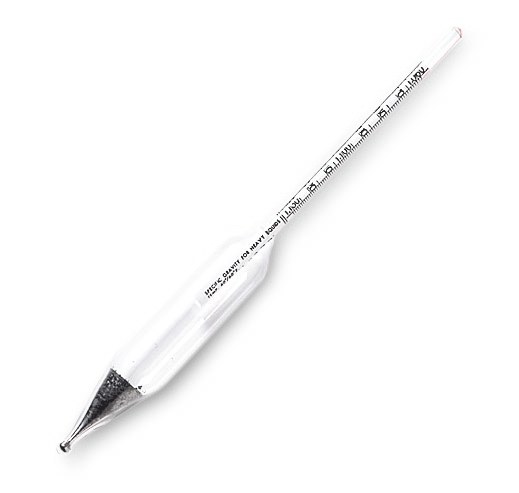
Specific gravity of aggregate is the dimensionless ratio of aggregate density to water density at a stated temperature. ASTM C127 for coarse aggregate and ASTM C128 for fine aggregate also determine water absorption, providing essential inputs for concrete and asphalt mix proportioning.
What the Test Measures
Bulk specific gravity includes permeable pores within the particle volume and may be stated on oven-dry (OD) or saturated surface-dry (SSD) mass. Apparent specific gravity excludes permeable pore volume. Absorption is the water held in permeable pores, expressed as a percentage of oven-dry mass.
| Reported property | Mass basis and volume |
|---|---|
| Bulk SG (OD) | Oven-dry mass divided by bulk particle volume |
| Bulk SG (SSD) | SSD mass divided by bulk particle volume |
| Apparent SG | Oven-dry mass divided by impermeable solid volume |
Mix designs use SSD as a neutral basis because SSD aggregate neither absorbs batch water nor contributes surface water.
Apparatus and Sampling
Use balances with appropriate capacity and resolution, a water tank and suspended basket for coarse material, and a pycnometer, mould and tamper for fine material. Control water temperature and remove trapped air. Towels for coarse SSD preparation must be absorbent without shedding fibres; fine SSD determination requires the standard cone test.
Obtain a representative sample and separate sizes where the method requires. The sieve analysis method supports grading, but excessive washing or handling can lose fines or alter porous particles.
Calibrate the fine-aggregate pycnometer at the working temperature and inspect the coarse basket suspension for free clearance from tank walls and base. Select balance capacity so submerged coarse mass and fine pycnometer mass remain within range while still resolving absorption changes. Begin the 24-hour soak from a documented time and keep fractions covered. For coarse SSD work, standardise towel condition and weigh immediately after surface drying; for ASTM C128, assign an experienced operator to recognise the cone slump point. Log water temperature with every mass set, retain OD, SSD and immersed observations separately, and use a calculation sheet that labels bulk OD, bulk SSD and apparent specific gravity explicitly.
Coarse Aggregate Procedure: ASTM C127
- Wash the sample to remove dust, then soak in water for 24 hours.
- Remove it, roll particles in an absorbent cloth until visible surface water is gone, and weigh immediately in the SSD condition.
- Place the sample in the wire basket, remove trapped air and determine mass while submerged in temperature-controlled water.
- Dry to constant mass in the oven, cool without moisture gain and determine OD mass.
Surface drying is the judgement-sensitive stage. Water films make SSD mass too high, while prolonged towel drying removes pore water and makes it too low. Work consistently and promptly.
Fine Aggregate Procedure: ASTM C128
Soak the prepared fine aggregate for 24 hours, decant excess water and dry it gradually while mixing. Check SSD using the cone: fill and tamp as prescribed, lift vertically, and identify the point at which the moulded fine aggregate just slumps. Over-dry material must be re-wet and reconditioned rather than guessed back to SSD.
Introduce a known SSD mass to the calibrated pycnometer, add water and eliminate air by the prescribed agitation or vacuum procedure. Bring to calibration volume and temperature and weigh. Finally determine oven-dry mass. Air bubbles or temperature mismatch directly bias displaced-water volume.
Calculations, Values and Reporting
For coarse aggregate, combine OD mass, SSD mass and submerged mass in the ASTM C127 equations for bulk OD, bulk SSD and apparent SG. For fine aggregate, combine OD mass, SSD test mass and the pycnometer masses in the ASTM C128 equations. Calculate absorption (%) = (SSD mass − OD mass) ÷ OD mass × 100.
Typical aggregate SG values are about 2.4–2.9. Absorption can be below 0.5% for dense igneous aggregate and above 4% for porous material. These are descriptive ranges, not universal acceptance limits. High absorption affects batch-water correction and can indicate porosity, but durability should also be assessed using tests such as Los Angeles abrasion and aggregate impact value.
Report method, fraction, water temperature, masses, each SG definition and absorption separately. Never label a result simply “specific gravity” without stating OD, SSD or apparent basis.
Common Errors & How to Avoid Them
- Leaving a water film on coarse particles inflates SSD mass; towel each surface until sheen disappears without drawing water from pores.
- Passing the fine-aggregate cone end point makes the sample too dry; re-wet and recondition instead of estimating backward.
- Air trapped in a basket or pycnometer reduces displaced-water measurement; agitate or apply the prescribed vacuum until bubbles cease.
- Mixing water temperatures changes density and vessel volume; equilibrate sample, bath and pycnometer at the recorded condition.
- Weighing hot oven-dry material creates convection error and moisture instability; cool it in a protected container first.
- Losing fine particles during washing changes both mass and pore characteristics; use controlled decanting and complete transfers.
Do not interchange OD, SSD and apparent equations or report an unlabeled “SG”. Check pycnometer calibration and suspended-basket clearance before the series; contact with the tank wall invalidates submerged mass. Calculate absorption from the same paired specimen masses, and repeat any determination whose mass balance or duplicate agreement falls outside the method requirement.
Frequently Asked Questions
Why is SSD condition used in mix design?
SSD aggregate neither absorbs mix water nor adds free surface water, so batching water corrections start from a neutral SSD basis.
What is the difference between specific gravity and density?
Specific gravity is a dimensionless ratio to water at a stated temperature, while density is mass per unit volume and has units.
Recommended Apparatus
NL Scientific manufactures the Astm151h Astm152h Hydrometer Long Stem for this method. Browse the full Aggregate & Rock Testing Equipment range or request a quotation from our engineers.
