


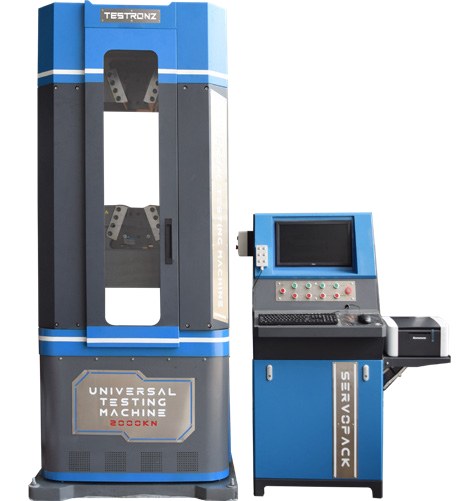
Force verification to ISO 7500-1 proves that a universal testing machine or compression machine indicates true force within class limits — the foundation of every valid tensile, compression and flexural result a laboratory reports.
What the Test Measures
The machine’s force readout is compared against a traceable force-proving instrument (load cell or proving ring) at multiple points over each working range. Relative indication error, repeatability, reversibility and zero error determine the machine class (0.5, 1, 2, 3).
Apparatus Required
- Force-proving instruments to ISO 376, calibrated and traceable to national standards (SAMM/SST in Malaysia)
- Adapters and compression platens/tension grips to load the proving device axially
- Resolution check tools and temperature monitoring (verification at 10–35 °C, stable to ±2 °C)
Test Procedure
- Exercise the machine to maximum force three times per range.
- Apply not fewer than five discrete forces (typically 20/40/60/80/100% of range) in three series, plus a repeatability series.
- Compute indication error q, repeatability b, reversibility v and zero error f0 for each range.
- Classify each range; affix the verification label and issue the certificate stating class and ranges verified.
Calculation & Reporting
Class 1 requires |q| ≤ 1.0%, b ≤ 1.0%, v ≤ 1.5%, zero error ≤ 0.05% of range. The certificate must list each verified range — a machine may be class 1 over 20–100% but unclassified below 20%.
Acceptance Criteria
Concrete and steel testing standards (EN 12390-4, ISO 6892-1, ASTM E4 equivalent) require class 1 machines verified at least every 12 months, and after relocation, overload or repair. Results from an out-of-verification machine are formally invalid.
Frequently Asked Questions
What usually causes a machine to fail verification?
Drifted electronics after years without service, worn spherical seats and platens introducing eccentric loading, hydraulic leak-down at low ranges, and damaged load cells from impact or overload.
Is a supplier calibration certificate the same as ISO 7500-1 verification?
Only if the work was performed to ISO 7500-1 by an accredited (ISO/IEC 17025) laboratory with ISO 376 proving instruments and the certificate states the class per range — a generic “calibration” sticker does not satisfy auditors.
Recommended Apparatus
NL Scientific manufactures the ELECTRO-HYDRAULIC Servo Control Universal Testing Machine 2000kN (6KS) for this method. Browse the full Steel Testing Equipment range or request a quotation from our engineers.
