


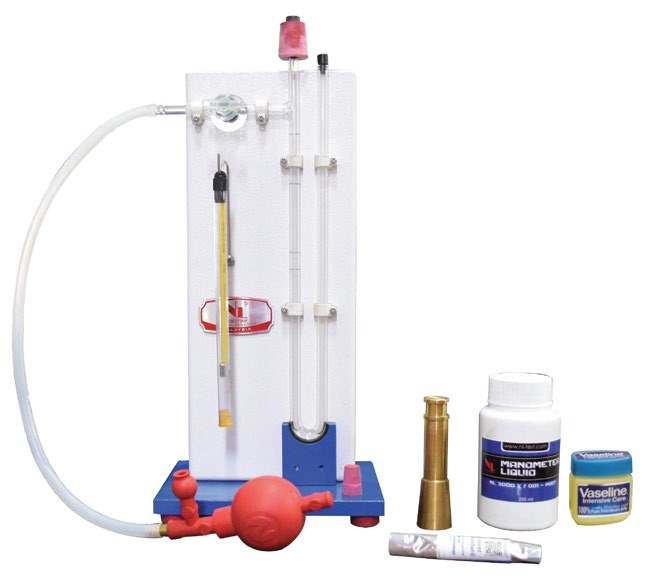
The Blaine air permeability test measures the specific surface area of cement — its fineness — which governs hydration rate, early strength development and water demand.
What the Test Measures
Air is drawn through a compacted bed of cement of defined porosity, and the time for a fixed volume of air to pass is measured. Finer cement packs a denser labyrinth, slowing the airflow; specific surface (cm²/g or m²/kg) is computed relative to a reference cement of known surface.
Apparatus Required
- Blaine apparatus: permeability cell, plunger, perforated disc and U-tube manometer (manual) or automatic Blaine unit
- Manometer liquid (dibutyl phthalate or light mineral oil) and filter paper discs
- Reference cement (e.g. NIST SRM 114 series) for calibration
- Balance (0.001 g), timer (0.2 s) and thermometer
Test Procedure
- Calibrate the cell constant with reference cement at bed porosity 0.500.
- Weigh the cement mass to give e = 0.500 for the cell volume; build the bed between filter papers and compact with one plunger stroke.
- Draw the manometer liquid to the top line, close the valve, and time its fall between the marked lines.
- Run duplicate beds; results must agree within the standard’s repeatability (about 1–2%).
Calculation & Reporting
S = Sref × (√t / √tref) × density and temperature corrections per the standard. Report the mean specific surface to the nearest 10 cm²/g with bed porosity and temperature.
Acceptance Criteria
Ordinary Portland cement typically runs 300–400 m²/kg (3000–4000 cm²/g); rapid-hardening cements 400–550 m²/kg. EN 197 sets no direct fineness limit — control is against the plant’s declared values — while low results correlate with slow early strength.
Frequently Asked Questions
Why is bed porosity fixed at 0.500?
The Kozeny–Carman relation behind the method assumes a standard packing. Changing porosity changes airflow resistance independent of fineness, so the mass is always back-calculated to hit e = 0.500 exactly.
How often must the apparatus be recalibrated?
Re-determine the cell constant with reference cement after any change of filter paper batch, manometer liquid, or cell components, and at least every six months in routine plant labs.
Recommended Apparatus
NL Scientific manufactures the Blaine Air Permeability Apparatus for this method. Browse the full Cement & Mortar Testing Equipment range or request a quotation from our engineers.
