


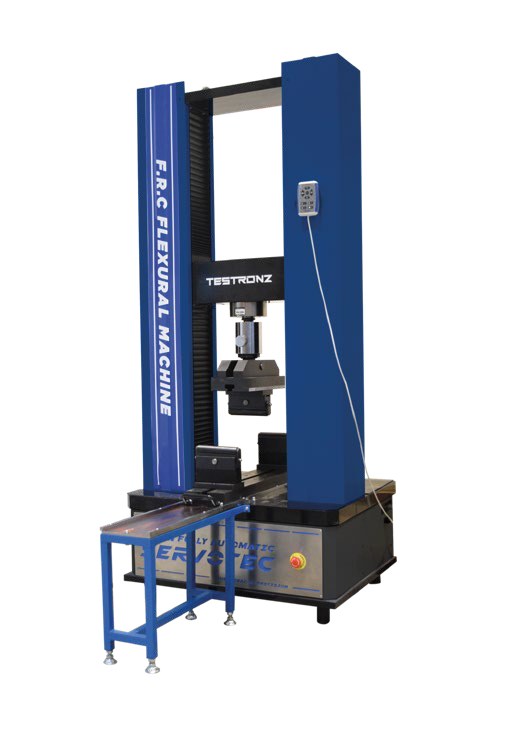
The concrete flexural strength test determines the modulus of rupture of a hardened concrete beam — the tensile strength of concrete in bending. It is the reference test for pavement and airfield slab design, where slabs fail in flexure rather than compression.
What the Test Measures
A prismatic beam specimen (typically 100×100×500 mm or 150×150×750 mm) is loaded until failure using centre-point or third-point loading. The stress at rupture in the extreme fibre is reported as flexural strength, usually 10–15% of the compressive strength.
Apparatus Required
- Flexural testing machine or flexural frame attachment with two support rollers and one or two loading rollers
- Beam moulds (100 or 150 mm square section) and compaction equipment
- Steel rule and square for locating rollers
- Curing tank maintained at 20 ± 2 °C (EN) or 23 ± 2 °C (ASTM)
Test Procedure
- Cast and cure beam specimens; test saturated, immediately after removal from curing.
- Mark support and load positions; centre the beam on the rollers with the trowelled face out of contact.
- Apply load without shock at a constant stress rate of 0.04–0.06 MPa/s (EN 12390-5) until rupture.
- Record maximum load and the fracture position.
Calculation & Reporting
For third-point loading with fracture inside the middle third: fcf = F·L / (b·d²), where F is the maximum load, L the span, and b, d the section dimensions. Report to the nearest 0.1 MPa with specimen size, curing regime and fracture location.
Acceptance Criteria
Typical structural concrete achieves 3–5 MPa flexural strength at 28 days; rigid pavement specifications commonly require a characteristic value of 4.0–4.5 MPa. If fracture falls outside the middle third by more than 5% of the span (third-point method), the result is discarded.
Frequently Asked Questions
Centre-point or third-point loading — which should I use?
Third-point loading (ASTM C78, EN 12390-5) stresses the whole middle third equally and gives more representative, slightly lower values than centre-point loading (ASTM C293), which forces failure at one section. Specify the method when reporting.
Can flexural strength be estimated from compressive strength?
Only approximately — correlations such as 0.7√f’c are mix-specific. Pavement acceptance should always use measured beam results, not converted cube or cylinder values.
Recommended Apparatus
NL Scientific manufactures the Fully Automatic Flexural Testing Machine for FIBER-REINFORCED Concrete 300kN for this method. Browse the full Concrete Testing Equipment range or request a quotation from our engineers.
