


The Le Chatelier soundness test checks that cement will not expand destructively after setting — unsoundness caused by free lime or magnesia can crack and disintegrate hardened concrete months after placing.
What the Test Measures
Cement paste is sealed in a small split brass cylinder fitted with two long indicator needles. After curing and then boiling, any expansion of the paste opens the split and spreads the needle tips; the increase in tip distance is the soundness expansion.
Apparatus Required
- Le Chatelier moulds (split brass cylinders 30 mm dia. with 150 mm indicator needles) and glass cover plates with weights
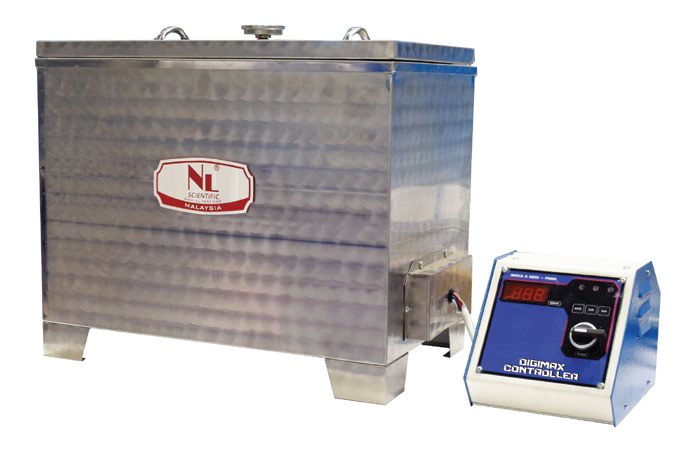
- Le Chatelier water bath capable of raising to boiling in 30 ± 5 min and holding 3 h
- Standard consistency apparatus (Vicat) to prepare paste at standard consistency
- Measuring scale readable to 0.5 mm; curing cabinet at 20 °C / ≥90% RH
Test Procedure
- Fill two moulds with paste of standard consistency; cover with weighted glass plates.
- Cure 24 h at 20 ± 1 °C, high humidity; measure needle tip distance (A).
- Heat to boiling over 30 min and boil 3 h; cool and measure again (C).
- Expansion = C − A for each mould; report the mean.
Calculation & Reporting
Report mean expansion of two specimens to 0.5 mm. If the two results differ excessively, repeat with fresh paste. Where high expansion is found, the standard permits retesting after 7-day aeration of the spread cement.
Acceptance Criteria
EN 197-1 limits Le Chatelier expansion to ≤ 10 mm for all common cements. Well-produced Portland cement typically expands 0.5–3 mm. Note the test detects free-lime unsoundness; magnesia unsoundness requires the autoclave test (ASTM C151).
Frequently Asked Questions
What causes cement unsoundness?
Hard-burnt free CaO or MgO that hydrates slowly with volume increase after the paste has hardened, and excess gypsum in extreme cases. Modern kiln control makes failures rare — the test is a safeguard on stored or suspect cement.
Why boil the specimens?
Boiling accelerates hydration of free lime that would otherwise react over months in service, revealing delayed expansion within a single working day.
Recommended Apparatus
NL Scientific manufactures the Le Chatelier Water Bath for this method. Browse the full Cement & Mortar Testing Equipment range or request a quotation from our engineers.
