


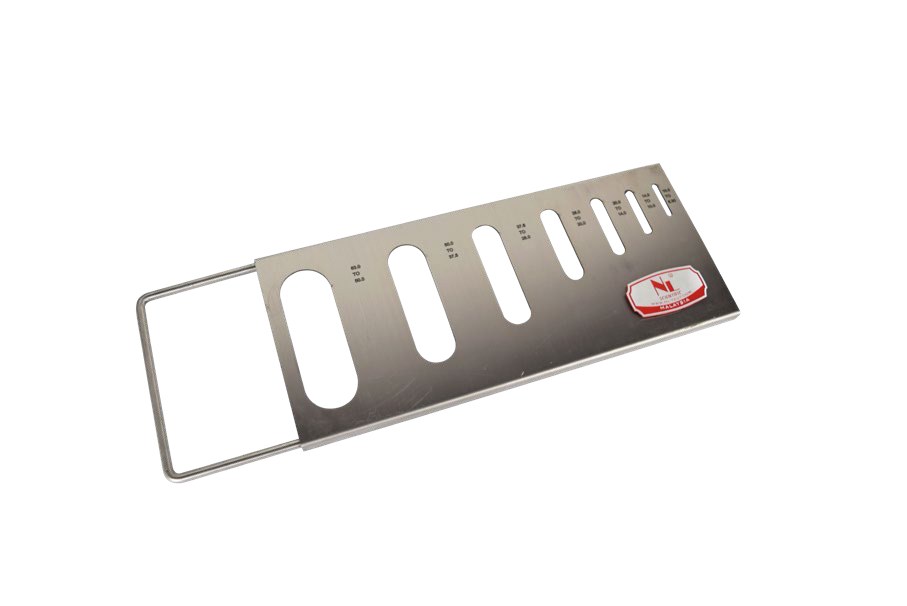
The flakiness and elongation index tests quantify particle shape of coarse aggregate. Flaky (thin) and elongated (long) particles pack poorly, break under compaction and weaken both concrete and asphalt skeletons.
What the Test Measures
Flakiness index (FI) is the percentage by mass of particles whose least dimension is less than 0.6 of their nominal size, measured with a slotted thickness gauge. Elongation index (EI) is the percentage whose greatest dimension exceeds 1.8 of nominal size, measured on a length gauge.
Apparatus Required
- Metal flakiness (thickness) gauge with standard slots, or matching bar sieves
- Elongation (length) gauge with fixed pegs
- Test sieves to split the sample into size fractions (63–6.3 mm range)
- Balance readable to 0.1% of sample mass
Test Procedure
- Sieve the dried sample into individual size fractions; discard fractions below 6.3 mm and any fraction under 5% of the sample.
- For each fraction, attempt to pass every particle through the corresponding gauge slot — particles passing are flaky.
- For elongation, test each particle against the corresponding peg gap — particles that cannot pass between pegs are elongated.
- Weigh flaky and elongated portions per fraction.
Calculation & Reporting
FI = total mass of flaky particles / total sample mass × 100; EI likewise. Report per-fraction and combined indices with the fractions tested. (Note: EN 933-3 flakiness uses bar sieves and gives slightly different values — state the standard.)
Acceptance Criteria
Common limits: FI ≤ 35 for concrete aggregate, ≤ 25–30 for asphalt wearing courses and ≤ 20 for surface dressing chippings; elongation limits typically mirror flakiness. Crushed granite from well-set cone crushers normally achieves FI 15–25.
Frequently Asked Questions
Why do flaky particles matter in asphalt?
They orient flat under rollers, block aggregate interlock, and snap under traffic — raising binder demand and rutting risk. Wearing-course specs therefore carry the tightest shape limits.
Can flakiness be improved at the quarry?
Yes — choke-feeding cone crushers, correct closed-side settings and vertical-shaft impactors in the final stage all reduce flaky output substantially.
Recommended Apparatus
NL Scientific manufactures the Flakiness / Thickness Gauge for this method. Browse the full Aggregate & Rock Testing Equipment range or request a quotation from our engineers.
