


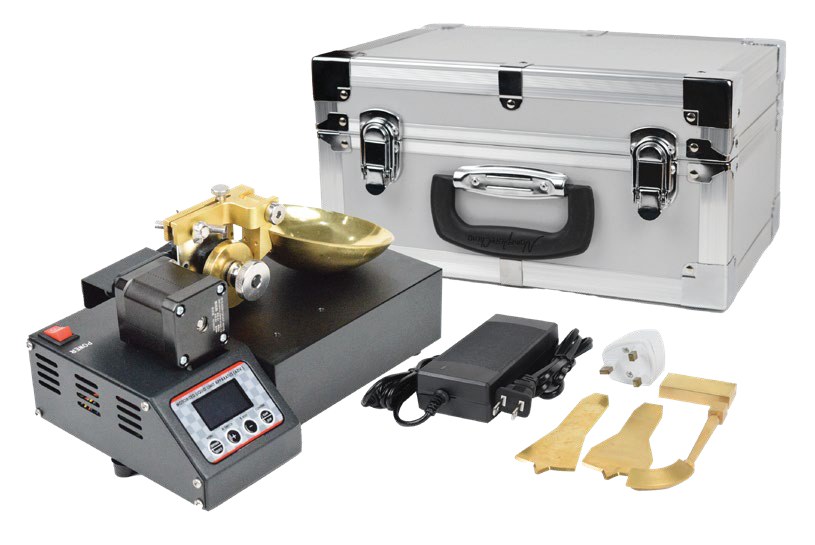
The Atterberg limits test defines the water contents at which a fine-grained soil changes behaviour — the liquid limit (LL), plastic limit (PL) and the derived plasticity index (PI = LL − PL). These values classify clays and silts and predict settlement and swelling behaviour.
What the Test Measures
LL is the moisture content at which soil passes from plastic to liquid state; PL is the content at which it begins to crumble when rolled to a 3 mm thread. Together they anchor the Unified and AASHTO classification systems via the plasticity chart.
Apparatus Required
- Casagrande liquid limit device with grooving tool (ASTM) or 80 g / 30° cone penetrometer (BS 1377-2 definitive method)
- Glass plate and 3 mm rod gauge for plastic limit rolling
- 425 µm sieve, mixing dishes, spatulas
- Moisture content tins, balance (0.01 g) and drying oven at 105–110 °C
Test Procedure
- Prepare about 200 g of soil passing the 425 µm sieve, mixed to a stiff paste and matured.
- Cone method: fill the cup, drop the cone for 5 s, record penetration; repeat at increasing moisture until four points span 15–25 mm penetration. LL = moisture content at 20 mm penetration.
- Casagrande method: groove the soil pat and count blows to close 13 mm; LL = moisture at 25 blows from the flow curve.
- Plastic limit: roll threads to 3 mm until they crumble; take the moisture content of the crumbled threads.
Calculation & Reporting
Report LL, PL and PI to the nearest whole number with the method used. Plot PI against LL on the plasticity chart: above the A-line (PI = 0.73(LL−20)) the soil is clay (C), below it silt (M); LL > 50 marks high plasticity.
Acceptance Criteria
Typical values: low-plasticity clay LL 30–50, PI 10–25; high-plasticity clay LL > 50, PI > 25. Earthworks specifications commonly cap PI (e.g. sub-base PI ≤ 6, structural fill PI ≤ 20) — check the governing road authority spec.
Frequently Asked Questions
Cone penetrometer or Casagrande — which is better?
The fall cone is the definitive BS/Eurocode method: it is operator-independent and more repeatable. The Casagrande device remains the ASTM reference; results differ slightly, so state the method with every result.
Why must the sample pass the 425 µm sieve?
Atterberg limits describe the fine fraction only. Coarser particles interfere with the groove and thread behaviour and would bias both LL and PL upward.
Recommended Apparatus
NL Scientific manufactures the Motorized Liquid Limit Apparatus (ADV) for this method. Browse the full Soil Testing Equipment range or request a quotation from our engineers.
