


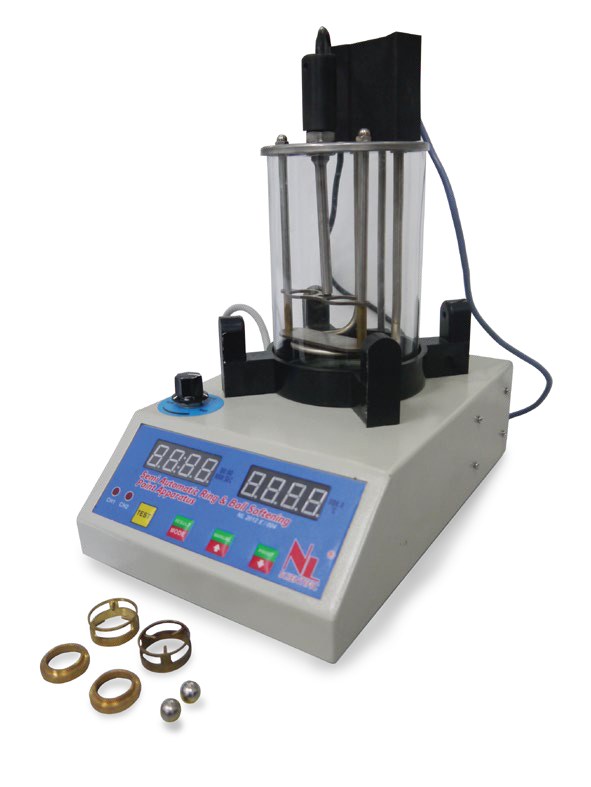
The ring and ball softening point test measures the temperature at which bitumen reaches a defined consistency — the upper service temperature indicator that pairs with penetration to characterise paving grades.
What the Test Measures
Two bitumen-filled brass rings, each loaded with a 3.5 g steel ball, are heated in a liquid bath at 5 °C/min. The softening point is the mean temperature at which each sagging bitumen disc touches the base plate 25 mm below.
Apparatus Required
- Ring and ball apparatus: brass shouldered rings, ball-centering guides, 3.5 g steel balls, support frame with 25 mm drop
- 600 ml bath beaker with stirrer; heater with 5 ± 0.5 °C/min control (automatic units preferred)
- Calibrated thermometer or PT100 probe
- Bath media: freshly boiled distilled water (softening points 30–80 °C) or glycerol (80–150 °C)
Test Procedure
- Heat the sample (max 110 °C above expected softening point), pour into preheated rings, cool 30 min and trim flush.
- Assemble rings, guides and balls in the bath at 5 ± 1 °C (water) and hold 15 min.
- Heat at 5 °C/min with stirring; record the temperature as each ball-and-bitumen envelope touches the base plate.
- If the two results differ by more than 1 °C (water bath), repeat the test.
Calculation & Reporting
Report the mean of the two temperatures to the nearest 0.2 °C (EN) or 0.5 °C with bath medium stated. Glycerol results read slightly higher and must not be compared directly with water-bath values.
Acceptance Criteria
Typical paving bitumen: 60/70 pen grade softens at 49–56 °C; 80/100 at 45–52 °C; polymer-modified binders 60–80 °C. A softening point below spec signals over-softness and rutting risk at Malaysian pavement temperatures.
Frequently Asked Questions
How does softening point relate to penetration?
Inversely — harder (low penetration) bitumen softens at higher temperature. The penetration index computed from both values indicates temperature susceptibility of the binder.
Why must distilled, freshly boiled water be used?
Dissolved air forms bubbles on the bitumen surface during heating, insulating the disc and biasing the result high; salts change the heating profile. EN 1427 requires freshly boiled distilled water for that reason.
Recommended Apparatus
NL Scientific manufactures the Semi Automatic Ring & Ball Softening Point Apparatus for this method. Browse the full Bitumen & Asphalt Testing Equipment range or request a quotation from our engineers.
