


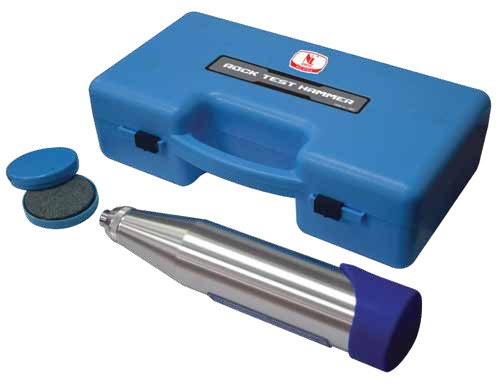
The rebound hammer test (Schmidt hammer) is the most widely used non-destructive check of in-place concrete, estimating surface hardness and, through correlation, compressive strength uniformity.
What the Test Measures
A spring-driven plunger impacts the concrete surface and the rebound distance is read as a rebound number (R). Harder, stronger concrete rebounds further. The test assesses uniformity and comparative quality; it is not a replacement for core or cube strength results.
Apparatus Required
- Rebound hammer (Type N, impact energy 2.207 Nm, for normal structures) with reading scale or digital display
- Abrasive stone for surface grinding
- Reference anvil for calibration verification (expected R ≈ 80 on steel anvil)
Test Procedure
- Verify hammer on the reference anvil before and after each series.
- Grind a smooth, dry test area of at least 300×300 mm; avoid surfaces with honeycombing, carbonated skin or coatings.
- Hold the hammer perpendicular to the surface; take at least 9 readings (EN) spaced not less than 25 mm apart and 25 mm from edges.
- Record the orientation (horizontal, vertically up/down) — rebound values must be corrected for impact direction.
Calculation & Reporting
Report the median rebound number per EN 12504-2. Discard the set if more than 20% of readings differ from the median by more than 30%. Strength estimation requires a correlation curve established against cores or cubes from the same concrete.
Acceptance Criteria
Rebound numbers for normal structural concrete typically range 25–50. Values are affected by carbonation (up to +50% overestimate on old surfaces), moisture and aggregate type — grind carbonated layers and correlate before judging strength compliance.
Frequently Asked Questions
How accurate is the rebound hammer for strength?
With a mix-specific correlation, ±15–20% at best. Without correlation it should only rank areas of the same structure for uniformity or locate suspect zones for coring.
How often should the hammer be calibrated?
Verify on the steel anvil each day of use; return the hammer for servicing and recalibration after roughly 2,000 impacts or whenever anvil readings drift outside the manufacturer’s band.
Recommended Apparatus
NL Scientific manufactures the Rock Test Hammer for this method. Browse the full Concrete Testing Equipment range or request a quotation from our engineers.
